




 VOLUME 30, ISSUE 1 • March 2026. Full issue »

Session Highlight: 2026 PAS Congress
From mechanisms to management: Gait impairment in Parkinson’s disease
During MDS's 6th Pan American Congress, a comprehensive session focused on "Integrating digital tools in the assessment and treatment of gait disorders in Parkinson’s disease." This program explored the mechanisms and potential of emerging technologies in reshaping clinical practice and research in movement disorders. The session aimed to achieve three key learning objectives, delivered by Dr. Gonzalo Revuelta, Dr. Martina Mancini, and Dr. Tamine Capato, and chaired by Drs. Catalina Cerquera and Gonzalo Revuelta.
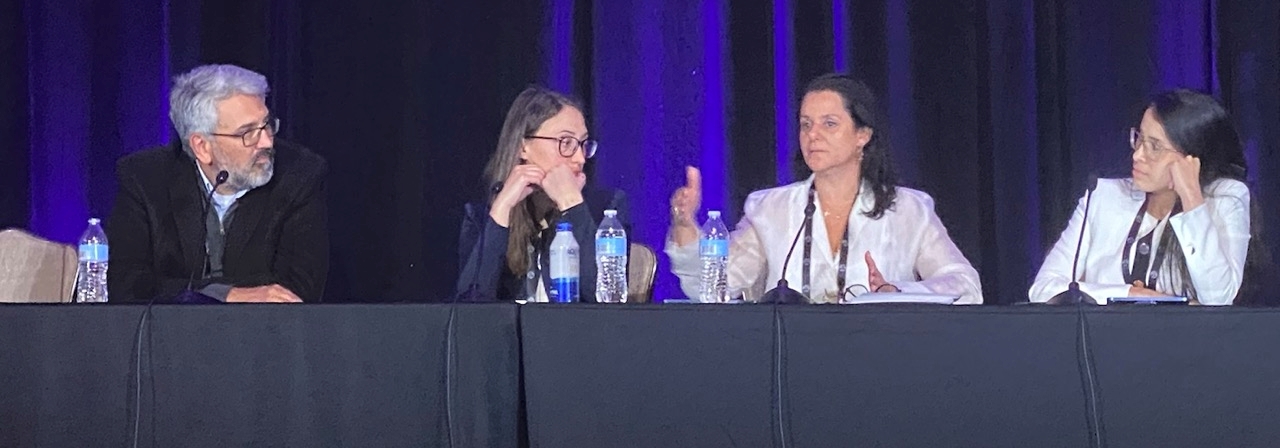
Session Faculty Dr. Gonzalo Revuelta, Dr. Martina Mancini, Dr. Tamine Capato, and Dr. Catalina Cerquera (chair).
First, Dr. Revuelta described the pathophysiological mechanisms underlying gait impairment and freezing of gait (FOG) in Parkinson's disease (PD), with an emphasis on non-dopaminergic factors. He highlighted that the pathophysiology of FOG is complex and heterogeneous, with contributions from the motor, cognitive, and limbic networks. Therapeutic interventions can be developed to target network-specific dysfunction with neuromodulation, rehabilitation, or manipulation of neurotransmitters.
A fundamental dysfunction in the motor network is the lack of automaticity of locomotion, primarily thought of as a result of dopaminergic denervation. Compensatory processes for the lack of habitual control involve a shift toward voluntary or goal-directed control of locomotion. While this compensatory strategy can be effective at first, it is less efficient, slower, and can be interrupted by an external load, which can be motor, cognitive, or limbic, and can lead to FOG.
As the field advances toward accelerated stimulation and neuromodulation paradigms, personalized targeting, and rehabilitation, it's vital to assess both the behavioral outcomes of FOG and underlying network effects. Future studies should integrate neuroimaging and neurophysiological outcomes with standardized behavioral assessments to identify which cortical processes need adjustment, ultimately aiming to enhance compensatory adaptations and restore gait automaticity.
Second, Dr. Mancini reviewed the utility, limitations, and future direction of wearable technologies and digital gait markers across the spectrum of PD.
A real-time poll highlighted a major gap: although 78% of clinicians recognize the limitations of traditional gait clinical assessments (MDS-UPDRS, brief clinic-based observation, snapshots), 61% reported they are not yet using wearables for gait evaluation. This underscores the need for accessible, validated, and standardized digital tools.
Research from the past 20 years on gait has shown promising findings in supporting diagnosis by providing gait measures capable of distinguishing healthy gait from that of someone with early, untreated PD or REM sleep behavior disorders (RBD), and the ability to capture, with larger effects size than clinical scale, changes due to interventions and monitor gait changes with disease progression. Despite this strong evidence, the field has long lacked standardized guidelines, resulting in wide variability in protocols driven by differences in equipment, space, and study-specific aims.
A recent consensus paper proposed a set of minimum protocol guidelines for assessment in both clinical/laboratory and real-world settings, marking an important step toward harmonization, although widespread adoption is still needed to fully integrate gait outcomes into clinical trials.
Within this minimum protocol, examples from ongoing studies highlight the importance of the upper body, and specifically reduced arm swing during gait, to distinguish between early, untreated PD and healthy controls. Turning while walking is one of the most impacted aspects of gait in people with moderate PD. Real-world findings on gait suggest higher sensitivity than clinic/laboratory testing, with the unique possibility of quantifying fluctuations in gait over the course of the day and multiple days. However, the challenges of dealing with this highly variable and multi-dimensional dataset were reviewed.
Last, but not least, she emphasized the importance of both technology and algorithms to be specifically validated for use in people with PD.
Third, Dr. Capato discussed the current evidence supporting non-pharmacological interventions, including cueing, digital technologies, and robot-assisted rehabilitation, to enhance gait and balance in PD. She emphasized the significance of physiotherapy in managing gait issues throughout all disease stages, including FOG.
While there is strong evidence that exercise is a key area of exploration, identifying the optimal level of exercise needed to effectively improve FOG and influence the disease is important. Personalized gait rehabilitation plans were identified as vital, with a focus on appropriate intensity, dosage, and timing of exercise.
Emerging physiotherapy guidelines for PD highlight the positive impact of neurological gait rehabilitation on all gait patterns, improving gait (stride step, stride length, speed, turning, and functional mobility) and reducing FOG episodes and fall risk. The implementation of compensation strategies, usually guided by specialized physiotherapists, has become key to gait rehabilitation in PD, as conventional pharmacological treatments are often insufficient to ameliorate gait and balance deficits.
Additionally, examples of compensation strategies to overcome FOG were provided. The advances in technology and assistive technology, for example, visual laser devices, metronomes, mobile apps, exergames, virtual reality, digital platforms, and robotics, were discussed, explaining how they are changing the gait rehabilitation field in PD. Overall, the future of gait rehabilitation in PD is exceptionally promising, driven by rapid technological advancements, personalized interventions, and a deeper understanding of neuroplasticity. Innovative rehabilitation approaches are shifting the focus from merely managing symptoms to actively improving mobility.
In summary, the interplay between network and neurotransmitter changes is becoming clearer, allowing for therapeutic targets to emerge. As wearable-based, digital measures of gait are becoming more commonly used and approved, they could be soon be available to clinicians and physical therapists worldwide. As quantitative methods of analysis improve to capture FOG severity and rehabilitative approaches continue to develop, the path toward individualized therapeutic approaches for FOG is within reach closer. Common therapeutic interventions aim at either restoring automaticity (dopaminergic replacement, deep brain stimulation of deep locomotor centers, or dual task gait training) or improving compensatory responses (noradrenergic or cholinergic replacement targeting attention/executive function, or cueing strategies). Future studies should investigate whether neuromodulation can target specific network dysfunction to either increase compensatory adaptations, reduce maladaptive adaptations, or restore gait automaticity.
View all the latest MDS content about gait disorders »
Read more Moving Along: